

Bank Indonesia Institute hosted the launch of Monetary Whispers Across Space by Professor Iwan Jaya Azis on Tuesday, 21 July 2026. Published by Springer, the book explores how regional inequality shapes the transmission of monetary policy and why spatial disparities matter for Indonesia’s macroeconomic management. More than 250 participants attended via Zoom, with a further 56 joining through the YouTube livestream.
Opening the event, Cicilia Harun (Director of Bank Indonesia Research Center) reflected on Indonesia’s economic transformation over recent decades, while noting that the benefits of growth have not been distributed evenly across the archipelago. The persistence of disparities between Java and many other regions reflects decades of uneven infrastructure development, industrial concentration, and demographic advantages. Such differences are no longer simply questions of regional planning. They increasingly determine how national policies operate, making regional inequality a macroeconomic concern rather than solely a development issue. In this context, Monetary Whispers Across Space offers a timely contribution by inviting policymakers to reconsider the relationship between geography and monetary policy.
In his remarks, Iwan Jaya Azis (Professor, Cornell University and Universitas Indonesia, and Research Fellow, Bank Indonesia Institute) challenged the conventional assumption that monetary policy operates independent of geography. Drawing on structural analysis and extensive field surveys across Indonesia, he argued that regional disparities shape the allocation and circulation of credit. He noted that while economic activity is increasingly generated outside Java, around 76% of the resulting financial benefits ultimately flow back to Java, whereas only 40% of those generated in Java circulate to the rest of the country. This asymmetry creates a self-reinforcing cycle in which unequal regional development weakens the transmission of monetary policy, while policy implemented without addressing structural disparities inadvertently perpetuates regional inequality.
Five experts were invited to discuss the book. The first is Teddy Alamsyah (Chair of the association of Indonesian rural banks/PERBARINDO). He observed that rural banks operate under conditions fundamentally different from commercial banks, serving predominantly micro and small enterprises whose financing needs are closely linked to local economic cycles. Regulations designed for larger financial institutions often overlook these characteristics, limiting the ability of rural banks to support local economic development. Strengthening governance, accelerating digital transformation, and adopting a more proportionate regulatory framework would enable rural banks to play a more effective role in expanding access to finance across the regions.
Beyond financial intermediation, discussants emphasised that regional inequality reflects far more than differences in access to credit. Professor Bernadette Robiani (Universitas Sriwijaya) highlighted the importance of infrastructure, institutional quality, natural resource endowments, and local economic structures in shaping regional development. Drawing on her research on small industries in Southern Sumatra, she noted that many enterprises continue to rely on informal financing because they are unable to meet formal banking requirements. Addressing these constraints, she argued, requires closer coordination between local governments, financial institutions, and regional development agencies.
This broader institutional perspective was reinforced by Sudarno Sumarto (SMERU Research Institute) who suggested that the book ultimately raises questions extending beyond monetary policy to Indonesia’s overall development strategy. Infrastructure investment alone cannot narrow regional disparities unless accompanied by stronger institutions, human capital, and local governance. Regions operating under similar fiscal conditions frequently achieve different development outcomes because institutional capacity determines how effectively public investment is translated into sustained economic progress.
Luky Eko Wuryanto (Asian Infrastructure Investment Bank) echoed this view, describing the book as an important contribution that bridges regional science and macroeconomic policymaking. Aggregate national indicators often conceal substantial regional differences, leading policymakers to overestimate the effectiveness of nationwide interventions. Infrastructure remains essential, but balanced development also requires coherent industrial policy, institutional reform, stronger governance, and continued digital transformation.
Reflecting on the book’s academic contribution, Professor Budy Resosudarmo (ANU Indonesia Project) argued that its greatest strength lies in restoring geography to the centre of macroeconomic analysis. By combining formal economic modelling with extensive field evidence, the book demonstrates that monetary policy in an archipelagic economy cannot be understood solely through national aggregates. Instead, it opens new avenues for research into how spatial diversity shapes policy transmission and how Indonesia’s experience compares with that of other large developing economies.
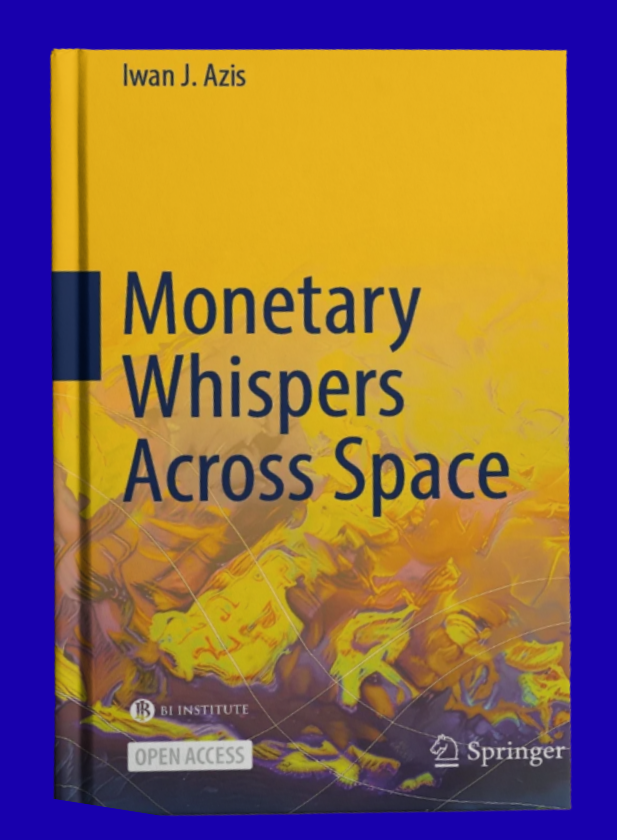
Download the full book (open access)
Monetary Whispers Across Space
Author: Iwan J. Azis
Date of publication: 2026
Publisher: Springer Nature Singapore
Number of pages: 130
Hard Cover ISBN: 9789819546244, eBook ISBN: 9789819546251
Read also media coverage of this event:
beritadaerah.co.id: Pertumbuhan meluas, ketimpangan terus membesar
![[FKP hosted by The SMERU Research Institute] Estimasi misinvoicing pada kasus larangan impor pakaian bekas](https://www.fkpindonesia.org/wp-content/uploads/2026/10/Collage-8-500x383.jpg)



Leave A Comment