
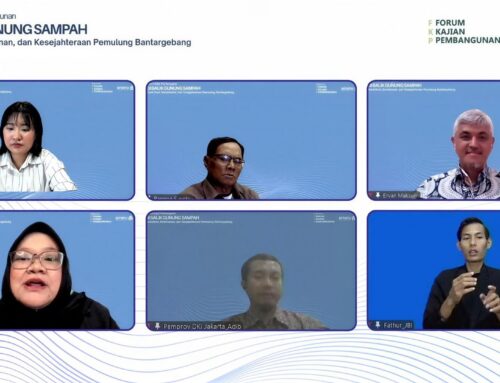
FKP hosted by The Australian National University on Thursday, 20 August 2026 with Lolita Moorena (The Australian National University) and Wisnu Setiadi Nugroho (Universitas Gadjah Mada)
Women in Indonesia have made significant gains in educational attainment, yet these advances have not translated into a comparable increase in female labor force participation. Since the early 2000s, participation among married women has increased, whereas it has declined among single women, particularly younger women. Given that married women account for approximately 70% of Indonesia’s working-age female population, understanding the factors shaping their employment decisions is essential.
Lolita Moorena (The Australian National University) presented her research examining how women’s decision-making power within their households influences their participation in the labor market. Drawing on data from the Indonesian Family Life Survey (IFLS) for 2000, 2007, and 2014, the study analyzes 15,284 married women and measures household decision-making power across 17 aspects of family life, including food, healthcare, education, and contraception. Establishing a causal relationship between women’s bargaining power and employment, however, presents a methodological challenge. Greater decision-making power may enable women to pursue employment, while having a job can also strengthen their position within the household.
To address this challenge, Lolita uses data on the staggered expansion of Integrated Service Centers for the Empowerment of Women and Children (Pusat Pelayanan Terpadu Pemberdayaan Perempuan dan Anak/P2TP2A) to see the impact on women labor market participation. The DV institutions were established across districts between 2004 and 2014 following the enactment of Indonesia’s 2004 Domestic Violence Law. These institutions provide services such as legal assistance, shelters, and counseling rather than employment programs. Their gradual introduction provides a research strategy for examining how institutional support for women may influence household decision-making and labor market outcomes.
The results indicate substantial improvements in labor market participation, particularly among women who had never worked before. Greater decision-making power increases their probability of entering the labor force by approximately 30 percentage points and adds around nine working hours per week. The likelihood of wage employment also increases by 11.7 percentage points, while the estimated effect on self-employment is not statistically significant. These findings suggest that women’s employment prospects depend not only on education, skills, and job availability but also on their ability to negotiate decisions within their families.
Reproductive autonomy may help explain these outcomes. Among women with no previous attachment to the labor market, greater decision-making power is associated with increased contraceptive use. Having more control over reproductive choices may allow women to plan pregnancies and consider employment opportunities more freely. The findings therefore point to a potential link between institutional protection, women’s bargaining power at home, and their ability to enter the labor market. In this respect, the effects of domestic violence legislation may extend beyond protection from violence to include broader improvements in women’s economic opportunities.
In his discussion of the paper, Wisnu Setiadi Nugroho (Universitas Gadjah Mada) highlighted a more complex finding: greater bargaining power also increases women’s involvement in unpaid family work. This raises an important question about the nature of their economic participation. Does unpaid family work serve as a stepping stone toward paid employment, or does it keep women economically active without providing them with independent earnings? Nugroho suggested using the IFLS panel data to track whether women initially engaged in unpaid family work subsequently transition into wage employment or self-employment. The central question is whether unpaid family work becomes “a ladder or a trap” for women.


Leave A Comment