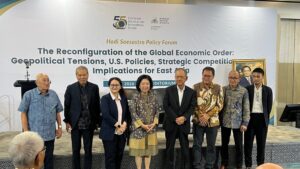
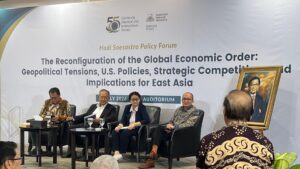

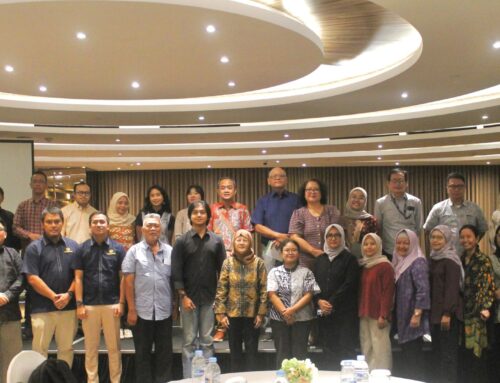
CSIS Indonesia and ANU Indonesia Project hosted the Hadi Soesastro Policy Forum on Wednesday, 9 July 2026 in Jakarta. The seminar honored the legacy of Dr Hadi Soesastro and his contributions to Indonesian policy and scholarship.
This year’s forum featured a keynote address by Narongchai Akrasanee (former Minister of Energy and Minister of Commerce, Thailand) entitled “The reconfiguration of the global economic order: geopolitical tensions, U.S. policies, strategic competition, and implications for East Asia.” The presentation was followed by a panel discussion with Poppy Sulistyaning Winanti (Universitas Gadjah Mada) and Arianto Patunru (ANU Indonesia Project). The event was well attended by more than 200 participants including Ambassadors of Kuwait, UAE, Serbia and Thailand.
In his remarks , Narongchai Akrasanee examined how the global economic order that supported East Asia’s transformation is facing fundamental challenges. The region’s economic rise was closely linked to an international system built on three foundations: an open economic order, multilateral cooperation, and rules-based institutions. These foundations enabled countries across East Asia to expand trade, attract foreign investment, and participate in regional production networks that became engines of industrialisation and economic growth. For decades, this framework provided the stability and predictability that allowed the region to integrate deeply into the global economy.However, the conditions that supported this era of growth are becoming increasingly uncertain.
Geopolitical rivalry, technological competition, and the growing use of economic policies as strategic instruments have blurred the traditional distinction between economic and security interests. Competition in areas such as advanced technology, artificial intelligence, and critical resources has transformed economic relations into a broader contest over strategic influence. Against this backdrop, the challenge for East Asia is not whether to remain connected to the global economy, but how to preserve openness while reducing vulnerabilities in an environment where economic interdependence is increasingly shaped by geopolitical considerations.
The changing global environment has also altered how countries approach international cooperation. Poppy Winanti highlighted the emergence of a more fragmented international landscape, characterised by great power rivalry, weaker multilateral mechanisms, and more transactional forms of cooperation. For developing economies, maintaining flexibility through diversified partnerships has become increasingly important as economic and security considerations become more closely intertwined. Rather than choosing exclusive alignment with one major power, many countries are seeking to preserve policy space while continuing to engage with the global economy.
From an economic perspective,Arianto Patunru examined how Southeast Asia can strengthen its position in a more competitive global environment. Strategic autonomy, he noted, should not be understood as economic isolation, but as the ability to strengthen domestic capabilities while remaining connected to regional and global markets. Indonesia’s downstreaming policy illustrates both the opportunities and limitations of resource-based strategies. Critical minerals such as nickel, bauxite, copper, cobalt, and tin provide important strategic advantages, but resource ownership alone does not guarantee economic upgrading. Long-term benefits depend on technological development, industrial capacity, and the ability to move into higher-value segments of global production networks.
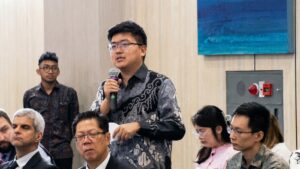
During the Q&A session, the discussion turned to one of the central dilemmas facing East Asia: how can the region preserve the benefits of economic openness when globalisation itself is becoming increasingly shaped by geopolitical competition? Responding to this challenge, Dr. Akrasanee emphasised that the answer is not toretreat from global integration or a move towards protectionism. Instead, East Asian economies must continue to strengthen connectivity and cooperation while adapting to a more uncertain international environment. The ability to remain open while managing new sources of vulnerability, he suggested, will be critical to sustaining the region’s economic success.
Leave A Comment