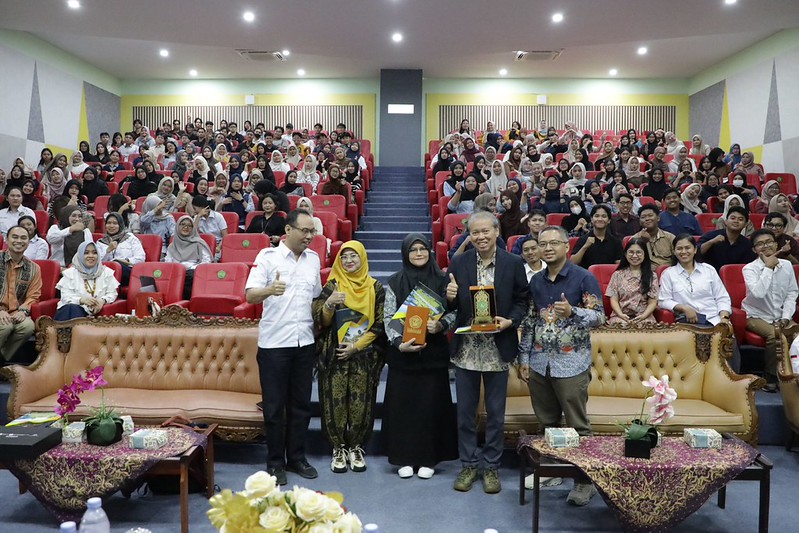
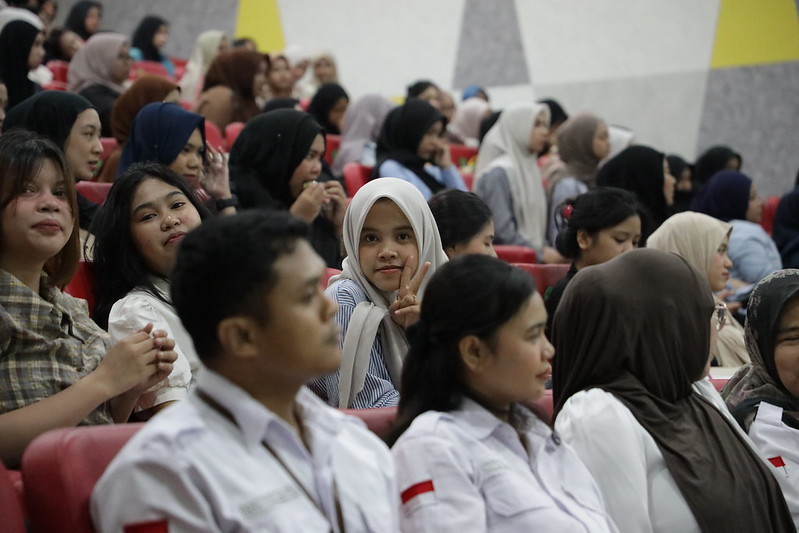
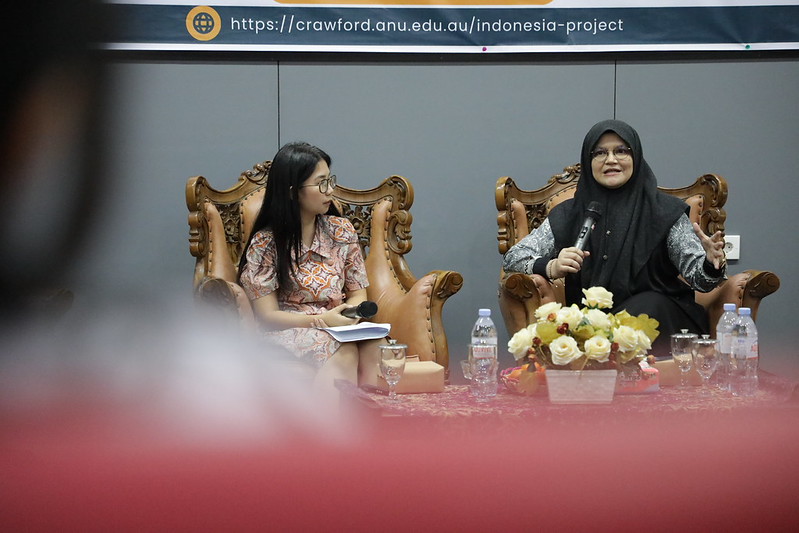
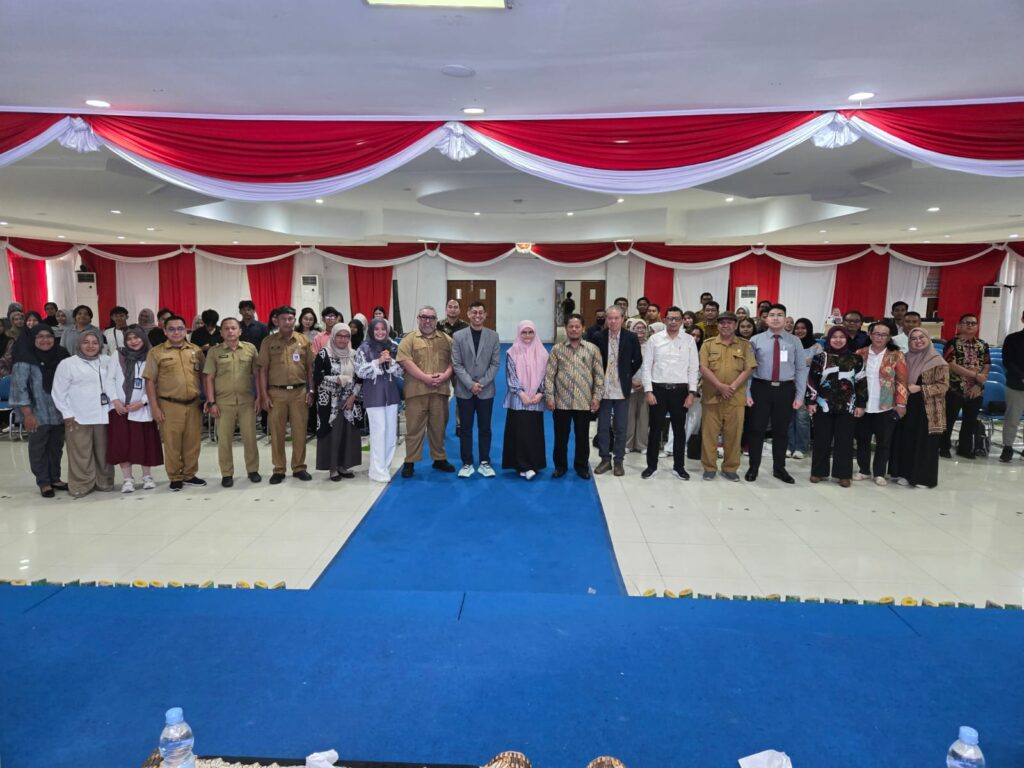
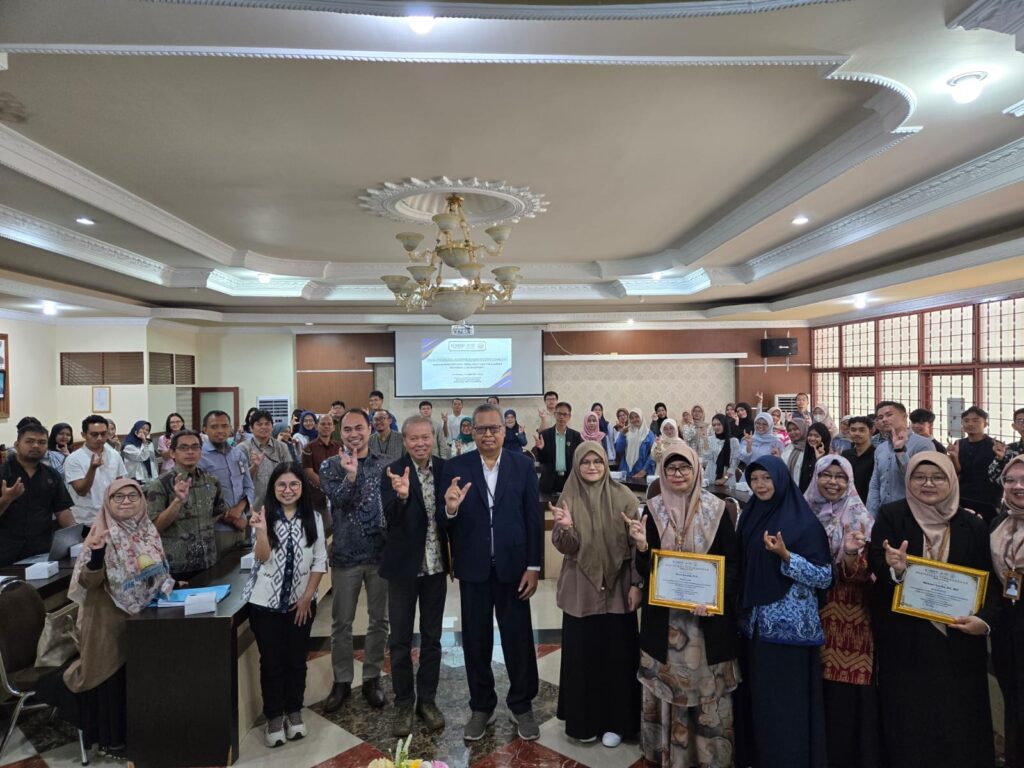
The 2026 FKP Roadshow was organised by the ANU Indonesia Project on the role of infrastructure in supporting economic development in eastern Indonesia, and notably in Kalimantan. The Roadshow was convened at Universitas Mulawarman (Monday, 26 January), Universitas Borneo Tarakan (Tuesday, 27 January), and Universitas Tanjungpura (Thursday, 29 January) and featured presentations by academics from each of the host university, from Universitas Telkom and from The Australian National University. The research presented addressed infrastructure challenges, regional disparities, and policy implications for strengthening connectivity and growth outside Java. Each seminar concluded with an open discussion to encourage critical exchange and comparative insights across regions.
More than 150 people attended the FKP Roadshow at Universitas Mulawarman and, respectively, 60 people and 80 people at Universitas Borneo Tarakan and Universitas Tanjungpura. A brief overview of each presenter’s study is given below. Slides may be downloaded from this link.
The Roadshow is supported by KONEKSI, a collaborative initiative by the Governments of Australia and Indonesia in the knowledge and innovation sector that supports partnerships between Australian and Indonesian organisations for inclusive and sustainable policy and technology.
Professor Budy Resosudarmo (Arndt-Corden Department of Economics, The Australian National University) presented a talk entitled Can air traffic booms induce innovation in eastern Indonesia? The presentation is based on a paper in The Annals of Regional Science co-authored with Inggrid. The research examines how increased air passenger traffic fosters innovation and whether it reduces innovation disparities between western versus eastern Indonesia. In their research, the authors used data on patent application to represent innovation. One of their main findings is that a 10-percentage point increase in domestic air passenger traffic corresponds to approximately a 5.6% increase in the number of patent applications. Therefore, higher levels of airline traffic (especially connecting eastern Indonesia with Java) have the potential to stimulate innovation; however, a certain level of development is required to facilitate the innovation, including stronger public universities supported by local governments.
Husneni Mukhtar (Universitas Telkom) presented research supported by KONEKSI which explores strategies to prevent and mitigate falls among the elderly, a growing public health concern in aging societies. This is an important topic as Indonesia is entering its population ageing period, where currently one in eight person is aged 60 and above. The research highlights how falls are not merely accidents but the result of an interaction of several risk factors including declining physical strength, chronic conditions, environmental hazards, and limited social support. The study emphasizes early risk identification, community-based interventions, and the role of healthcare systems in promoting balance training, safer home environments, and preventive education. By combining clinical insights with practical policy recommendations, Husneni Mukhtar argued that fall prevention requires coordinated action by families, communities, and institutions to improve quality of life and reduce long-term healthcare burdens.
Both Budy Resosudarmo and Husneni Mukhtar presented their paper at all the venues in the FKP Roadshow. In addition to their presentations, a host university researcher participated in the panel, and they are listed below.
Long viewed mainly as a source of raw materials, eastern Indonesia region, especially Kalimantan, is now experiencing faster growth and rising investment. Emmilya Umma Aziza Gaffar (Universitas Mulawarman) explained how eastern Indonesia is beginning to redefine its place in the national economy. Long viewed mainly as a source of raw materials, the region is now experiencing faster growth and rising investment. She argues that this shift is closely linked to infrastructure development. Roads, ports, and digital networks are not just construction projects. They shape how people trade, work, and connect with larger markets. When transport and logistics improve, distance becomes less of a barrier. In this way, infrastructure can help eastern Indonesia move from extraction toward production, spreading opportunity more widely across the region.
What is the role of financial development in supporting agricultural transformation and industrial growth? This is the topic explored by Margiyono (Universitas Borneo Tarakan) in his research which focused on access to finance. He argued that access to finance is a structural driver that enables productivity gains, technological adoption, and value-added expansion. By linking credit availability, investment flows, and sectoral performance, his research highlights how financial systems can accelerate structural change from agriculture toward industry. At the same time, the research also found persistent constraints including limited rural financial access and uneven institutional capacity. Therefore, strengthening financial inclusion and improving credit allocation are key to agricultural modernization and broader industrial development.
Nurul Bariyah (Universitas Tanjungpura) examined how road infrastructure and related fiscal and socio-economic factors shape economic growth and income inequality in West Kalimantan. Using panel data from 14 districts and cities (2020–2024) she found that road infrastructure alone does not significantly drive growth or reduce inequality. In contrast, Physical Special Allocation Funds (DAK-F) and education show stronger links to economic growth. However, education is also associated with rising inequality, reflecting uneven access and returns. Investment and population size appear insignificant in the short run. Thus, while infrastructure matters, it should also be supported by well-targeted policies in building human capital and institutional quality.
Please find slides in the folder here.
![[FKP hosted by The SMERU Research Institute] Estimasi misinvoicing pada kasus larangan impor pakaian bekas](https://www.fkpindonesia.org/wp-content/uploads/2026/10/Collage-8-500x383.jpg)