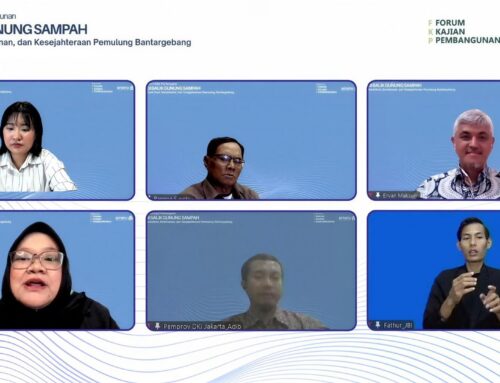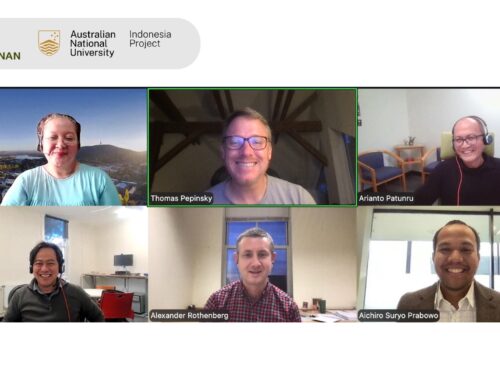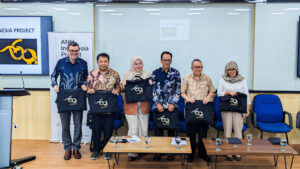
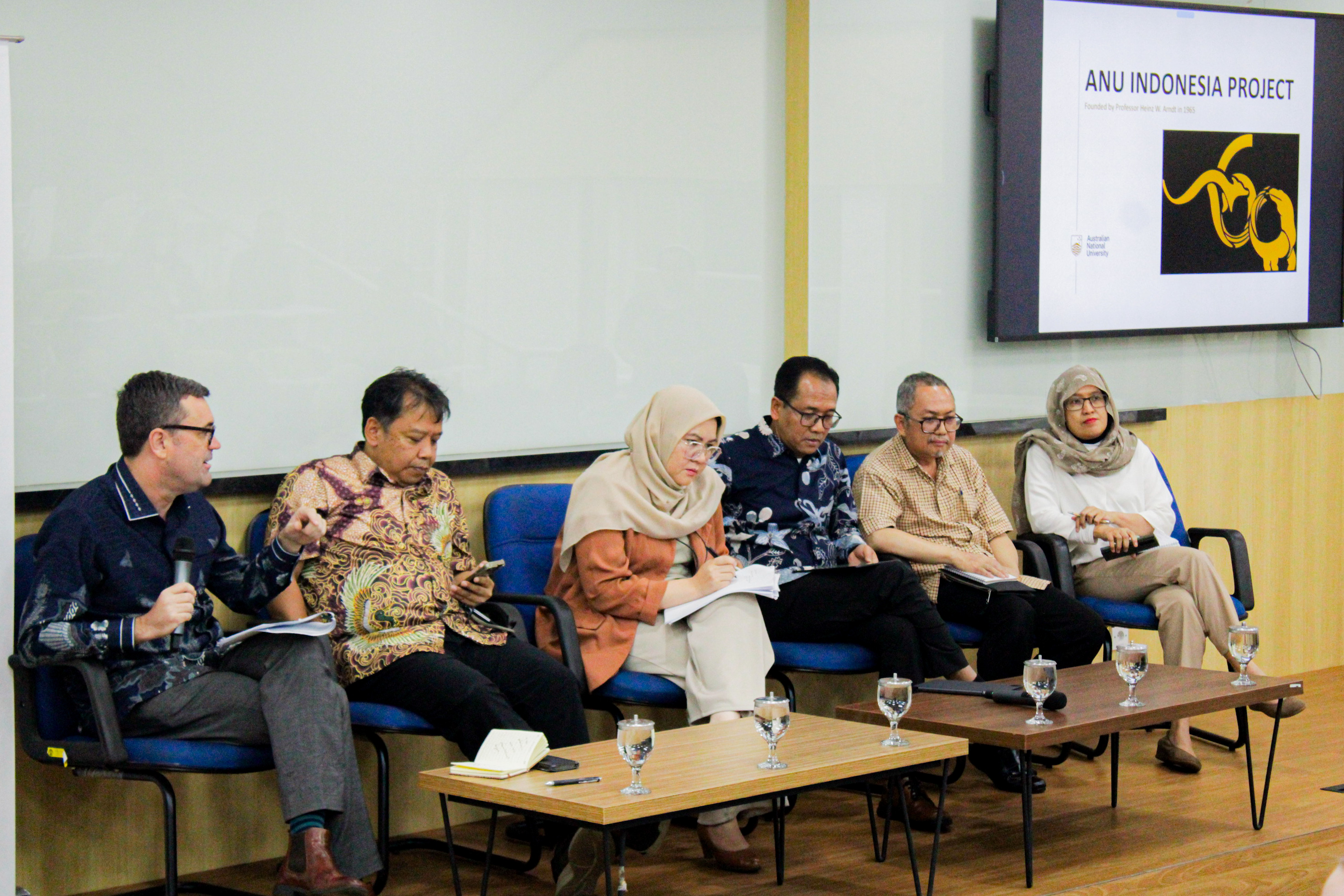
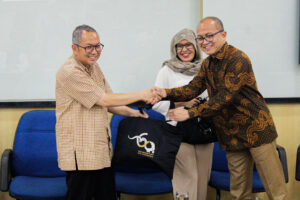
The ANU Indonesia Project , LPEM FEB Universitas Indonesia and The SMERU Research Institute hosted the Special FKP: ANU Indonesia Project PhD alumni policy forum on Tuesday, 12 August 2025 in Jakarta.
The seminar was opened by Professor Budy Resosudarmo (ANU Indonesia Project) who, with Arianto Patunru (Director of LPEM FEB UI at the time) initiated the FKP series at LPEM in 2009. At the time, LPEM’s afternoon discussion series (diskusi sore hari) was opened to the public and a mailing list was set up to send out invitations. Over time, other institutions offered to host the discussions, which led to the current FKP series with various organisations hosting events each month.
Jonathan Gilbert (Australian Department of Foreign Affairs and Trade / DFAT) delivered short remarks before three of ANU Indonesia Project PhD graduates Arief Yusuf, Deasy Pane, and Abdurahman presented their work.
Arief Anshory Yusuf (Dewan Ekonomi Nasional & Universitas Padjadjaran) delivered a presentation on the status of poverty and inequality in Indonesia. In his presentation, he emphasized the “last mile problem” in alleviating poverty which is which refers to the slowing pace of poverty reduction in recent years. He demonstrated that the reduction of poverty has significantly decelerated, particularly in metropolitan regions, where the average yearly decrease has been merely 0.3% since 2021. Additionally, Arief touched on Indonesia’s poverty threshold, which he considers antiquated and inadequately low, and jeopardizes an accurate assessment of hardship, perhaps omitting millions from consideration of being in poverty. He emphasized that measures, including the revision of the poverty line, the integration of registries into the new National Single Social and Economic Data (Data Tunggal Sosial Ekonomi Nasional/DTSEN) system, and the reinstatement of a formula-based minimum wage, are essential to align poverty reduction initiatives with actual social situations.
Indonesia’s industrial challenges were the focus of the second presentation delivered by Deasy Pane (BAPPENAS) on the topic of trade and industrial policy. In her presentation, Deasy showed how Indonesia is experiencing premature deindustrialization. The manufacturing sector’s contribution to GDP has declined to below 19%, while its worldwide export share has been stagnant at approximately 1% for the past two decades, in contrast to Vietnam’s which has doubled. Deasy also highlighted that Indonesia has had challenges in diversifying or ascending the global value chain, as exports remain predominantly reliant on commodities such as coal and palm oil. She cautioned that in the absence of a coherent, long-term industrial policy, the nation risks solidifying inefficient “zombie industries” instead of fostering competitive enterprises.
The last presenter was Abdurahman (ASEAN+3 Macroeconomic Research Office) delivering a presentation on macroeconomic issues. In his presentation, Abdurahman emphasized Indonesia’s resilience in the face of global uncertainties, sustaining a 5% growth rate despite protectionism and volatility. Domestic demand has facilitated recovery after the pandemic where the country exhibited decreasing unemployment and poverty, while reserves and debt remain constant. However, structural challenges endure: investment and manufacturing have declined, and the majority of the workforce continues to be engaged in low-productivity industries. Abdurahman contended that to achieve the Golden Indonesia 2045 goal, growth must increase to 6–7% per annum, underpinned by judicious short-term stability and comprehensive structural reforms.
Riatu Qibthiah (LPEM FEB UI) and Asep Suryahadi (The SMERU Research Institute) were discussants. Both of them emphasized the importance of inclusive fiscal and social policies in maintaining Indonesia’s development. Riatu emphasized that inadequate tax collection limits the state’s capacity to finance social and infrastructural initiatives, necessitating the expansion of the tax base, enhancement of expenditure efficiency, and reinforcement of the redistributive function of fiscal policy. Asep emphasized ongoing inequality and vulnerability, indicating that numerous households are at risk of reverting to poverty due to shocks like climate change, food price fluctuations, or health emergencies. He advocated for flexible social protection systems integrated with labor market and educational changes, guaranteeing that growth not only increases GDP but also provides security and opportunities for the most vulnerable populations. Additionally, Asep raised the alarm on the potential impact of the free lunch program to contribute to more income inequality if the program design is not carefully put in place and impact evaluations are not undertaken. Their viewpoints collectively emphasized that fiscal reform and enhanced social protection must be integrated to ensure Indonesia’s change is really inclusive.
The Q&A session highlighted a question from the audience regarding Indonesia’s increasing fiscal challenges and state-owned enterprise exposure in relation to the 1990s crisis. Abdurahman responded by emphasizing that despite existing vulnerabilities such as regulatory uncertainty and dependence on state-owned enterprises, Indonesia’s fundamentals are significantly stronger today, characterized by reduced external debt, increased reserves, and more robust financial markets. He concluded that a recurrence of the 1997–98 crisis is improbable yet, reforms to enhance budgetary sustainability and bolster investor confidence are critically necessary.
![[FKP hosted by The SMERU Research Institute] Estimasi misinvoicing pada kasus larangan impor pakaian bekas](https://www.fkpindonesia.org/wp-content/uploads/2026/10/Collage-8-500x383.jpg)