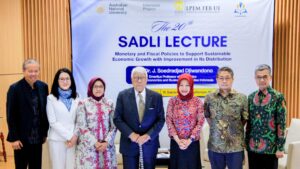
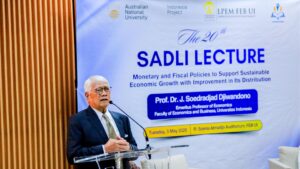

LPEM FEB Universitas Indonesia and ANU Indonesia Project hosted the 20th Sadli Lecture on Tuesday, 5 May 2026 at Universitas Indonesia, Depok. This year’s lecture was delivered by Professor (Emeritus) Soedradjad Djiwandono (Governor of Bank Indonesia from March 1993 – February 1998) entitled Monetary and fiscal policies to support sustainable economic growth with improvement in its distribution.
In his Lecture, Professor Soedradjad Djiwandono examined the institutional deficiencies shown during the Asian Financial Crisis of 1997/1998 and their consequences for economic policy coordination. At the time, the disintegration of the interbank market compelled Bank Indonesia to infuse around Rp90 trillion into the banking system to avert systemic banking collapse, while liquidating 16 distressed institutions, including several associated with politically powerful individuals. The conditions heightened both the economic and political costs of crisis management, as Bank Indonesia had not attained formal independence at the time rendering monetary policy susceptible to political interference. Subsequent to the 1998 reforms, notably the independence of the central bank and enhanced prudential regulation, a significant institutional framework was established that contributed to Indonesia’s relative resilience during the 2008 Global Financial Crisis.
Soedrajad also identified inadequate fiscal capacity as a persistent structural constraint for Indonesia. Indonesia’s current tax ratio hovers between 8–11%, constraining the government’s capacity to finance productive investments and social protection amid external pressures. This figure is markedly lower than the approximately 16% attained during the late New Order era. The limited fiscal space diminishes policy flexibility and undermines the government’s capacity to facilitate long-term economic transformation. Consequently, the coordination of monetary policy, fiscal policy, and the real sector is crucial not only for short-term stabilization but also for bolstering long-term growth potential.
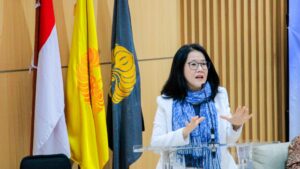
Currently, the ongoing stagnation of Indonesia’s economy has emerged as a pivotal concern. Although Indonesia has emerged as one of the major global economies in terms of purchasing power parity, economic growth has consistently hovered around 5% for over twenty years, while the manufacturing value added has remained stagnant at approximately 19–20% of GDP. The quality of investment continues to be subpar, as shown by an ICOR of approximately 6 and an FDI-to-GDP ratio of merely 1.61% in 2025. In her discussion, Dr. Lili Yan Ing (International Economic Association) highlighted that macroeconomic stability is inadequate without the backing of fiscal and monetary policy to facilitate structural transformation. Fiscal policy must shift from short-term consumption support to productive expenditure that enhances industrial capacity, human capital, and technological advancement. Meanwhile, in addition to achieving the inflation target, monetary policy must also foster an investment environment that enhances productivity and promotes long-term capital accumulation.
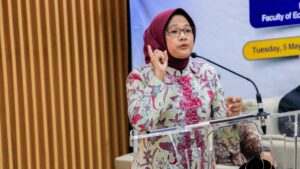
The discourse on macroeconomic coordination then shifted to Indonesia’s growing vulnerability in the current global environment. In her discussion, Dr. Titik Anas (Universitas Padjajaran) asserted that monetary and fiscal authorities cannot tackle external shocks separately, as fragmented policy actions would erode market confidence and intensify macroeconomic instability. Since January 2026, Brent oil prices have increased by nearly 62%, causing inflation to rise to 4.76 % in February 2026, beyond the government’s target range. The rupiah has simultaneously depreciated above Rp17,000 per US dollar, with cumulative capital outflows since the beginning of 2025 totaling Rp100.6 trillion. Collaboration among Financial System Stability Committee (KSSK) is crucial for maintaining policy credibility before the onset of financial distress. Fiscal discipline is essential in the context of rising commodity prices and capital outflows, as excessive fiscal expansion could intensify inflationary pressures and increase sovereign risk. In this framework, monetary policy functions as both a stabilizing instrument and a part of a holistic coordination system aimed at maintaining credibility, preserving investor confidence, and preventing the amplification of external shocks into systemic instability.
During the Q&A session, a participant inquired whether national monetary and fiscal coordination was adequate to address extensive global crises, or if enhanced regional monetary cooperation is necessary. In response to the inquiry, Soedradjad Djiwandono emphasized the significance of regional financial collaboration via frameworks like the Chiang Mai Initiative, contending that forthcoming crises will necessitate enhanced cross-border coordination instead of only national measures. Lili Yan Ing asserted that Indonesia ought to prioritize enhancing the quality of growth over merely achieving headline growth targets, advocating for strategic fiscal allocation that directs public expenditure towards sectors with significant multiplier effects on the wider economy, rather than short-term consumption initiatives. Titik Anas emphasized that sustaining investor confidence is largely contingent upon credible macroeconomic management, cautioning that ongoing fiscal constraints, currency rate fluctuations, and capital outflows might swiftly jeopardize economic stability if policy coordination deteriorates.
Access additional media coverage regarding the 20th Sadli Lecture:
Jakarta Globe: Prabowo’s Brother-in-Law Djiwandono Calls for Policy Sync to Secure Inclusive Growth
Jakarta Globe: Indonesia’s Growth Has ‘Plateaued’ at 5%, Economist Says
Jakarta Globe: Can Indonesia Sustain 5.61% Growth and Reach the 8% Target?
RRI: Sinkronisasi Fiskal dan Moneter Jadi Kunci Capai Tujuan Ekonomi Nasional
Egindo.Com :Sinkronisasi Fiskal-Moneter: Kunci Stabilitas Ekonomi di Tengah Ketidakpastian Global
![[FKP hosted by WRI Indonesia] Mengelola risiko banjir: politik kebijakan, tata ruang, dan adaptasi kota-kota pesisir di Indonesia](https://www.fkpindonesia.org/wp-content/uploads/2026/04/Collage-2-500x383.jpg)
![[FKP hosted by ANU Indonesia Project] Prabowonomics: can Indonesia really grow at 8%?](https://www.fkpindonesia.org/wp-content/uploads/2026/04/2026-01-15-2-500x383.jpg)
![[FKP hosted by JPAL Southeast Asia] The impact of growth chart on child growth and development with a summary of the first Global Scales for Early Development (GSED) implementation in Indonesia](https://www.fkpindonesia.org/wp-content/uploads/2026/01/2025-11-25-8-500x383.jpg)
![[FKP hosted by FEB UNUD] Apakah orang kota lebih sejahtera? Mengungkap akar ketimpangan ekonomi di Bali](https://www.fkpindonesia.org/wp-content/uploads/2026/03/2025-11-25-6-500x383.jpg)

Leave A Comment