UPDATE: INSTAGRAM CHALLENGE FOR UNDERGRADUATE STUDENTS, MORE ON FKP INSTAGRAM ACCOUNT @forum.pembangunan
The Hendra Esmara Lecture on Regional Development is convened by the Faculty of Economics and Business, Universitas Andalas and the Indonesian Regional Science Association (IRSA), and ANU Indonesia Project, in honour of the late Professor Hendra Esmara for his pioneering work in the field of regional analysis in Indonesia.
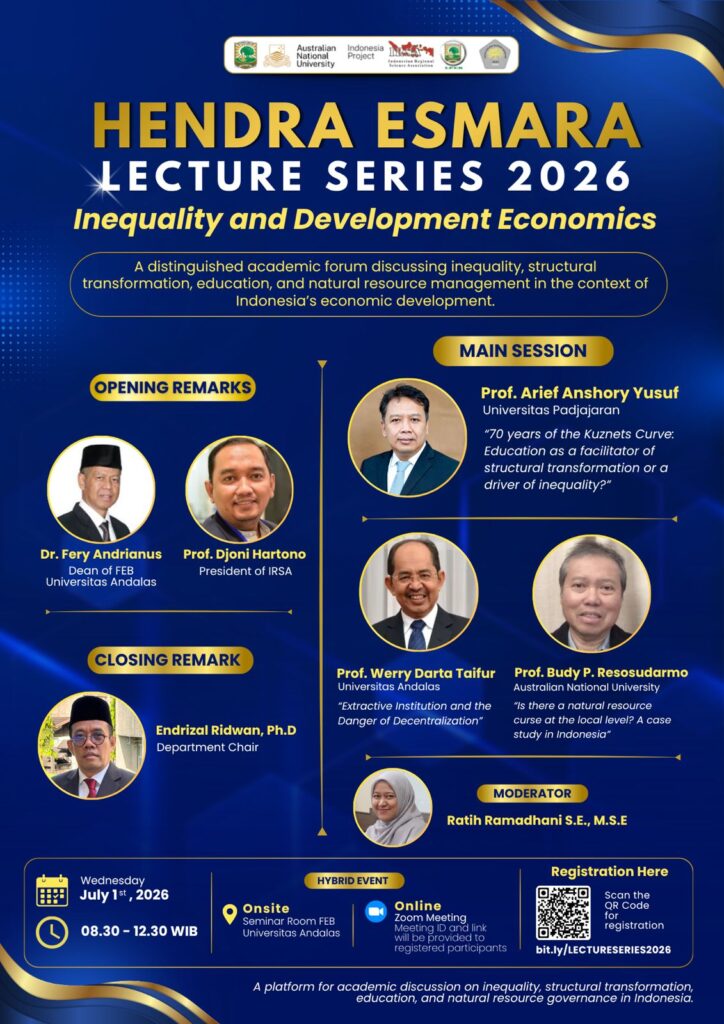
The 3rd Hendra Esmara Lecture on regional development will be delivered by Professor Arief Anshory Yusuf (Universitas Padjadjaran and Dewan Ekonomi Nasional) entitled Seventy years of the Kuznets Curve: is education a facilitator of structural transformation or a driver of inequality? Abstract of the talk is provided below.
The second part of the seminar will discuss extractive industries and regional inequality with Professor Werry Darta Taifur (Universitas Andalas), Professor Budy Resosudarmo (The Australian National University).
Both sessions will be chaired by Ratih Ramadhani (Universitas Andalas) and will feature Q&A. Please refer to the detailed program below.
 Wednesday, 1 July 2026 (hybrid in English)
 08.30 – 12.10 WIB (GMT+7)
 Seminar Room, Faculty of Economics and Business, Universitas Andalas and online on Zoom.
Register from this link.
Program
08:30 – 08:50 Opening
Dean, FEB Andalas
President, IRSA08:50 – 10:20 Hendra Esmara Lecture by Arief Anshory Yusuf ((Universitas Padjadjaran and Dewan Ekonomi Nasional)): Seventy years of the Kuznets Curve: is education a facilitator of structural transformation or a driver of inequality?
Q&A (30 minutes)10:30 – 12:00 Panel presentations on extractive industries and regional inequality
• Werry Darta Taifur (Universitas Andalas): Extractive institution and the danger of decentralization
• Budy P. Resosudarmo (The Australian National University): Is there a natural resource curse at the local level? A case study in Indonesia
Q&A (30 minutes)12:00 – 12:10 Closing by Head, Department of Economics, FEB Andalas
Simon Kuznets’s 1955 paper is widely — and inaccurately — remembered for an inverted-U curve he never actually proposed. His real contribution was the Kuznets process: the idea that inequality change depends on structural change, population growth, and the balance between within-group and between-group inequality. This presentation revisits that process through the lens of education, using Indonesia as a case study. Using a regression discontinuity design (RDD), we find that education facilitates labor’s move out of agriculture, but only into formal, modern employment — the effect disappears for moves into the informal non-agricultural sector. Using recentered influence function (RIF) decomposition, we find that education accounts for a large share of the higher inequality observed in the modern sector, driven by the growing composition of educated workers rather than differences in returns to education. These findings suggest education facilitates structural transformation, but does not necessarily resolve the Kuznetsian tension between transformation and egalitarian development.
In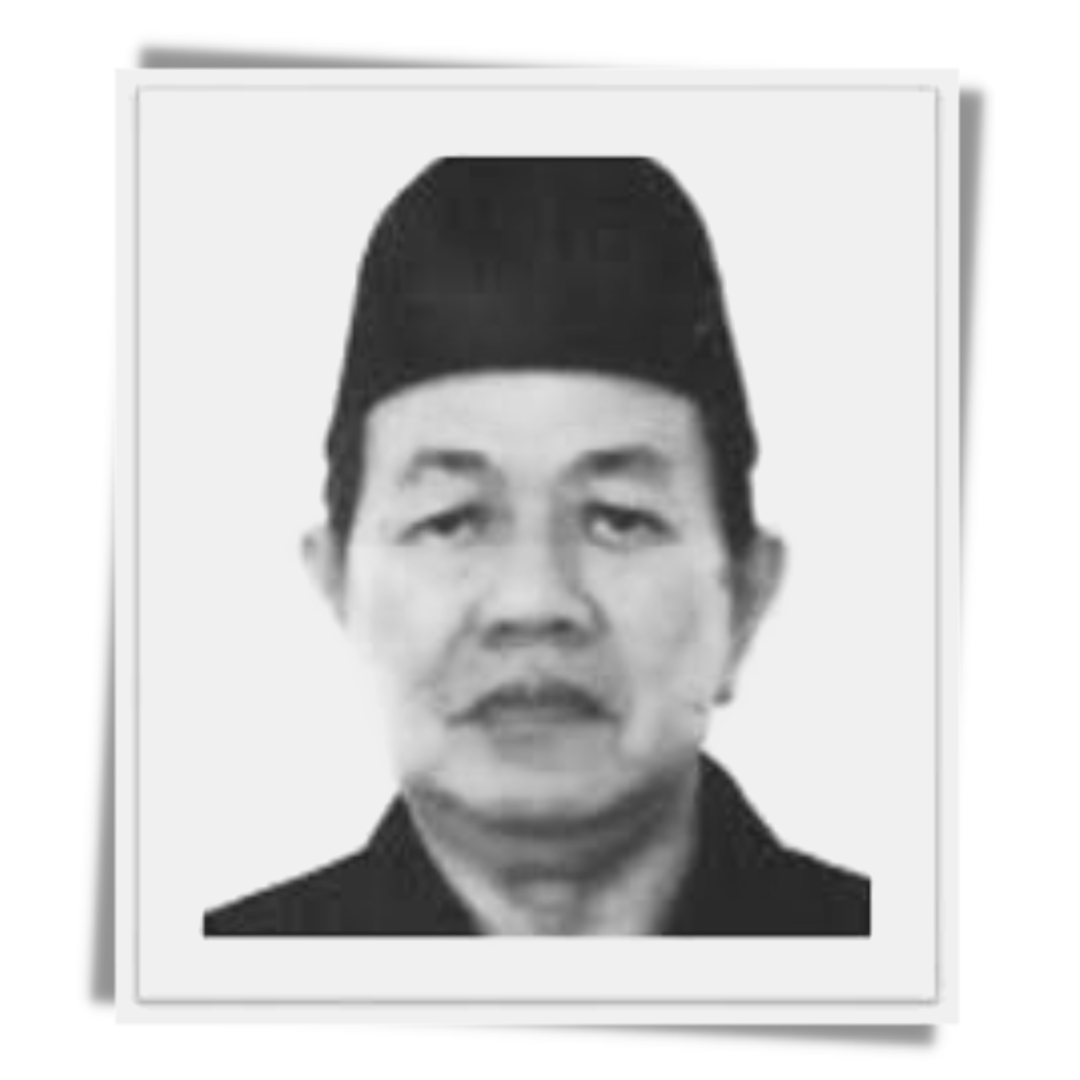 addition to his academic work, Professor Esmara served as advisor to numerous Indonesian government agencies including Statistics Indonesia (Badan Pusat Statistik) and BAPPENAS. He actively participated in managing the Indonesian Association for Economists (Ikatan Sarjana Ekonomi Indonesia) and supported the career of many junior economists in academia and government. He also played significant roles in international organizations. Among others, he was a member of the Executive Council for Asian Manpower Studies; member of the Steering Committee for the World Health Organization (WHO) research program on socio-economics of health in Geneva; and Deputy Executive Director of the Asia Pacific Economic Cooperation (APEC).
In 1985, Hendra Esmara was appointed professor of regional planning at Universitas Andalas, the first professor at the university’s Faculty of Economics. He served in this position until his passing on 13 August 2000.
Slides and video for past seminars: