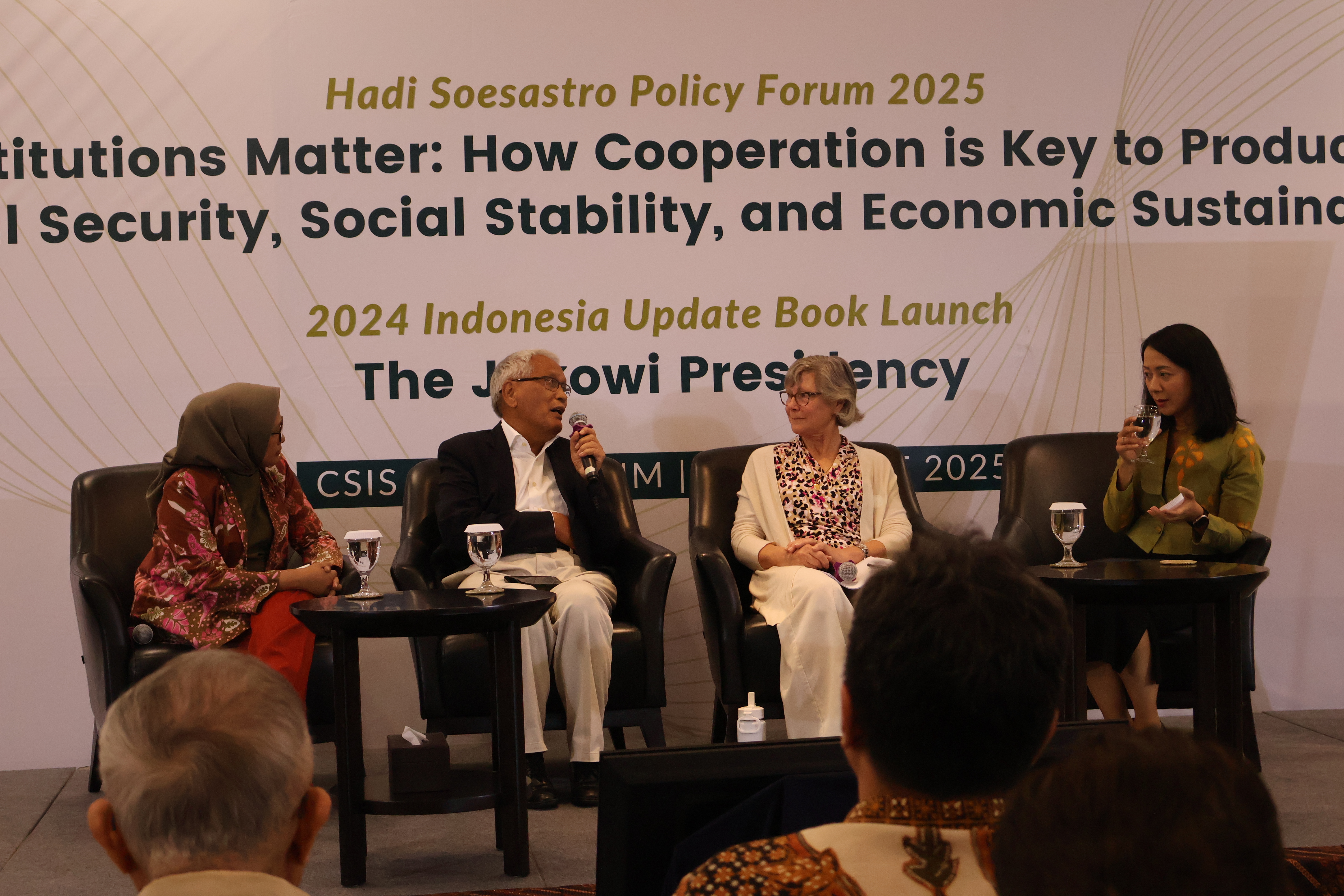

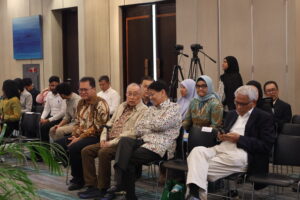
The ANU Indonesia Project and CSIS Indonesia hosted the Hadi Soesastro Policy Forum on Wednesday, 13 August 2025 in Jakarta. The seminar honored the legacy of Dr Hadi Soesastro and his contributions to Indonesian policy and scholarship.
This year’s forum featured a keynote address by Dr. Jenny Gordon entitled “Why institutions matter: how cooperation is key to productivity, national security, social stability, and environmental sustainability.” The presentation was followed by a panel discussion with distinguished Indonesian policy thinkers Professor Djisman Simandjuntak (CSIS) and Dr. Titik Anas (Universitas Padjadjaran).
In her remarks, Dr. Jenny Gordon (ANU & Lowy Institute) highlighted that well-functioning institutions underpin productivity, social stability, national security, and environmental sustainability. However, iInstitutions are not static, they must evolve alongside social and economic change. Gordon emphasized the importance of both competition and cooperation, and, while markets allocate resources efficiently, only strong institutions can establish the rules that make markets work fairly. She underscored that trust acts as a “lubricant” for institutions – lowering transaction costs and strengthening legitimacy. However, declining trust, whether due to corruption, inequality, or failure to deliver on promises, threatens this virtuous cycle.
Gordon also referenced international institutions, indicating that the efficacy of globalization in alleviating poverty is currently jeopardized. Post–World War II institutions like the IMF, World Bank, and WTO facilitated confident commerce and investment among nations, promoting global expansion. However, she cautioned that increasing inequality, changing geopolitical dynamics, and climatic challenges are eroding confidence in these institutions. Reform is needed, necessitating enhanced participation of the Global South, more explicit mandates, and collaborative leadership to prevent fragmentation into competing areas of influence. Institutions should aim to reconstruct cooperative frameworks capable of addressing global commons issues, such as climate change and digital security, while avoiding a world order governed by the principle of “might is right.”
In the discussion, Dr. Titik Anas (Universitas Padjadjaran) reflected on Indonesia’s experience, stressing that domestic reforms must go hand in hand with international cooperation. She pointed to Indonesia’s need for stronger institutions to sustain inclusive growth while engaging with global rules that shape trade, finance, and climate policy. The dialogue reinforced Hadi Soesastro’s enduring message: that robust, adaptable institutions are not only national assets but also the foundation of a fair and cooperative international order.
Professor Djisman Simandjuntak (CSIS Foundation) added a perspective on Indonesia’s institutional trajectory, noting the risks of institutional stagnation in the face of rapid social and technological change. He argued that Indonesia must avoid the pitfalls of “institutional involution”, where institutions become tools of vested interests, by ensuring transparency, accountability, and public trust. At the same time, he highlighted that regional and global engagement provides opportunities for Indonesia to learn, adapt, and contribute to strengthening multilateral institutions in a shifting geopolitical landscape.
During the Q&A session, a participant raised a question about how Indonesia can maintain institutional trust amid widening inequality and the perception that many citizens are excluded from the benefits of growth. Gordon responded that legitimacy depends on ensuring inclusive benefits through both domestic redistribution and effective participation in global governance. Anas and Simandjuntak agreed, stressing that without public confidence in institutions, efforts to strengthen international cooperation will lack credibility and durability.
For further insights on Dr. Jenny Gordon’s perspective, read her article published by the Lowy Institute: here and her Slides here.
![[FKP hosted by The SMERU Research Institute] Estimasi misinvoicing pada kasus larangan impor pakaian bekas](https://www.fkpindonesia.org/wp-content/uploads/2026/10/Collage-8-500x383.jpg)