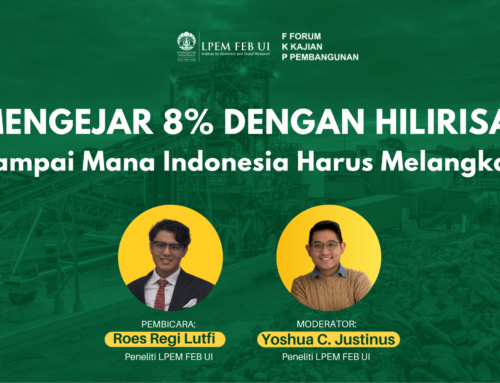
FKP hosted by LPEM FEB UI Wednesday, 28 May, 2025 with Mervin Goklas Hamonangan (LPEM FEB UI) and Alif Ihsan A. Fahta (LPEM FEB UI), and moderated by Irfan Adityo (LPEM FEB UI)
Indonesia’s aspiration to achieve an annual GDP growth of 8% by 2045 has emerged as a fundamental theme in national development strategies. Achieving such an objective requires not only political resolve or budget augmentation but also a profound comprehension of the nation’s true economic capabilities. Mervin Goklas Hamonangan and Alif Ihsan A. Fahta examined this bold aim and presented LPEM’s initial findings in an FKP seminar. By examining Indonesia’s historical growth patterns, its current potential growth, and modeling future scenarios, they raised the crucial question: is 8% growth actually possible or just a pipe dream?
Mervin Goklas Hamonangan (LPEM FEB UI) began by going over earlier examples of Indonesia’s explosive economic expansion. He noted that while there were years like 1968, 1976, and 1995 when the economy grew by more than 8%, these were driven by extraordinary events like post-crisis recoveries, changes in the price of oil, or short-term deregulation. Neither an industrial revolution nor long-term increases in productivity were the cause of them. Mervin assessed Indonesia’s true development ceiling using univariate and multivariate filtering techniques. The Hodrick–Prescott, Butterworth, and Baxter–King filters were used to distinguish between cyclical fluctuations and trend growth. In order to create a structural estimator, he then used a multivariate framework that combined macroeconomic linkages.
The results were consistent across methodologies where Indonesia’s potential growth is currently estimated at 4.5% to 5% annually. Mervin contends that this figure reflects the economy’s true capacity, shaped by current productivity, labor dynamics, and capital efficiency. Aiming for an 8% growth rate without implementing structural reforms may strain fiscal resources, heighten inflation, and lead to macroeconomic instability. He highlighted that attaining sustained high growth requires more than temporary spending; it necessitates institutional reform, improved governance, and a comprehensive industrial strategy, similar to the developmental trajectories seen in Korea and China.
Alif Ihsan A. Fahta (LPEM FEB UI) presented potential scenarios of the needed resources to achieve 8% GDP growth, using both production-oriented and expenditure-oriented economic models. He employed a traditional growth accounting framework (Cobb–Douglas production function) to analyze GDP by breaking it down into contributions from capital, labor, and Total Factor Productivity (TFP). The findings suggest that capital accumulation remains the principal driver of growth, while labor contributions have decreased, and total factor productivity, an essential indicator of efficiency and innovation, has declined. Achieving 8% growth in this scenario necessitates a substantial increase in Total Factor Productivity, reversing its current trend.
What would it take to achieve 8% GDP growth in terms of governmental expenditure, investment, and improved capital efficiency? In one scenario, attaining an 8% growth exclusively through government expenditure would require annual increases exceeding 30%, leading to a fiscal deficit of 6–8% of GDP, which substantially exceeds the legal threshold of 3%. In another scenario, merely increasing investment would require a substantial improvement in a few years, a standard rarely achieved by emerging nations. Finally, a balanced scenario that integrates both expenditure and investment require a considerable increase in tax revenue (from 10% to 23% of GDP), posing a significant political and administrative challenge.
During the Q&A session, a participant asked whether achieving full employment could be adequate to drive 8% growth. The LPEM research team had examined this issue and concluded that while employment is important, the quality of work and output are significantly more critical. The labor market in Indonesia is primarily characterized by informality, with a significant number of workers engaged in low-skill, low-output sectors. Mervin emphasized the need for improved vocational education and a stronger alignment between the workforce and industrial demands. Alif asserted that without the formalization of labor and substantial innovation, the workforce alone will not achieve the growth levels projected by politicians.
Download slides from FKP gdrive: klik
![[FKP hosted by The SMERU Research Institute] Estimasi misinvoicing pada kasus larangan impor pakaian bekas](https://www.fkpindonesia.org/wp-content/uploads/2026/10/Collage-8-500x383.jpg)