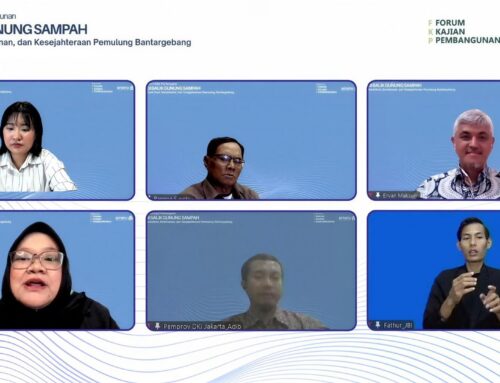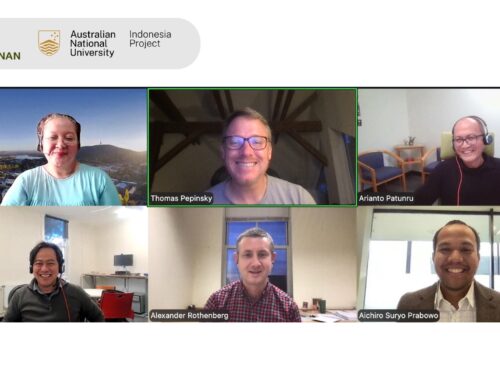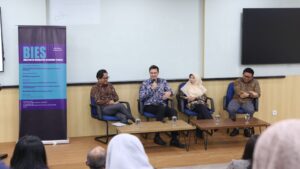
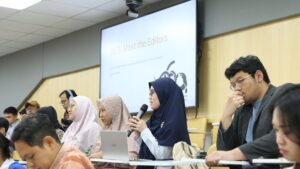
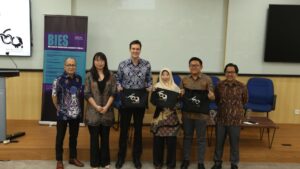
The BIES Economic Forum hosted by ANU Indonesia Project and LPEM FEB UI with Jahen Rezki (LPEM FEB UI), Anna Falentina (Statistics Indonesia/BPS), Cosimo Thawley (Australian Treasury), Firman Witoelar (ANU Indonesia Project), Sarah Dong (ANU Indonesia Project), Arianto Patunru (ANU Indonesia Project). The discussion was chaired by Yohanna Gultom (FEB UI).
Bulletin of Indonesian Economic Studies (BIES) is widely recognized as the leading international journal on Indonesia’s economy and society. Established in 1965 and based at the ANU Indonesia Project, BIES has provided a trusted platform for connecting academic research with policy debates. Each edition features original studies and the flagship Survey of Recent Developments, which has become a vital reference for policymakers, scholars, and analysts seeking to understand Indonesia’s economic shifts. For many researchers, publishing in BIES is both a professional milestone and an opportunity to influence broader debates on Indonesia’s development.
The first session highlighted the experiences of recent authors who successfully published in BIES. Jahen Rezki (LPEM FEB UI) spoke of perseverance in the face of early rejections, explaining how careful revisions and responses to reviewers helped transform his work such as his study on Indonesia’s energy transition into widely cited contributions. Anna Falentina (BPS) shared her perspective as a practitioner. For her, publishing in BIES required moving beyond technical statistical analysis to frame findings within broader policy questions. She noted that, while daunting, the demanding review process ultimately improved the clarity and relevance of her research. Cosimo Thawley (Australian Treasury) described the challenges of co-authoring the Survey of Recent Developments, which requires combining rigorous economic analysis with timely assessments of political and macroeconomic events. He emphasized the value of collaboration and discipline when working under tight deadlines. Taken together, their stories showed that while the process can be demanding, it leads to research that is clearer, stronger, and more influential.
The second session turned to the BIES editors’ perspective on what distinguishes successful submissions. Firman Witoelar (ANU Indonesia Project), Sarah Dong (ANU Indonesia Project), and Arianto Patunru (ANU Indonesia Project) explained that BIES accepts only about 4% of submissions, reflecting its commitment to quality. Successful articles begin with a strong and relevant research question rooted in Indonesia’s economic context; are supported by sound theoretical and empirical analysis;, and are written in clear language accessible to both academic and policy audiences. Even excellent research may fail if it lacks structure, presents a weak abstract, or does not connect with Indonesia’s policy debates. The editors offered practical tips such as to design manuscripts with flexibility to accommodate reviewer suggestions; to treat the abstract as a “sales pitch,”; and to maintain a consistent writing style across co-authored work. Most importantly, they encouraged authors to view peer review as a collaborative process rather than an adversarial one, approaching revisions with humility and persistence.
During the Q&A session a participant asked how to choose strong topics and how to cope with rejection. The editors advised that originality can only be achieved through wide reading and awareness of ongoing debates, while rejection should be seen as an inevitable but useful part of the publishing journey. Others asked about methodological trends, particularly the rise of causal inference. The editors emphasized that while methodological rigor is essential, BIES does not favor one approach over another. The priority is to publish transparent, well-executed analysis that addresses issues relevant to Indonesia. Finally, questions on desk rejections drew a clear answer: many submissions fail because they do not engage sufficiently with Indonesia’s policy context or because the writing is weakly organized.
![[FKP hosted by The SMERU Research Institute] Estimasi misinvoicing pada kasus larangan impor pakaian bekas](https://www.fkpindonesia.org/wp-content/uploads/2026/10/Collage-8-500x383.jpg)