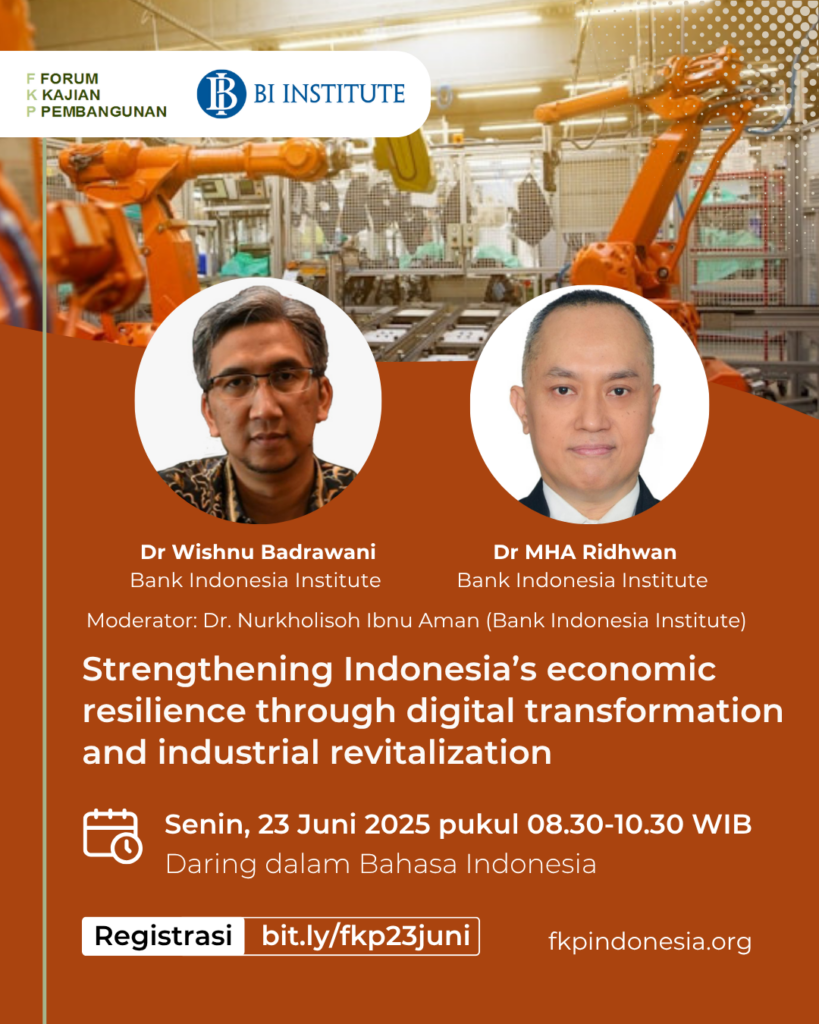
Dalam konteks ketidakpastian ekonomi global dan upaya pemulihan pascapandemi, Indonesia menghadapi tantangan sekaligus peluang untuk memperkuat fondasi pertumbuhan ekonominya. Seminar ini menghadirkan dua penelitian yang relevan dengan dinamika tersebut. Dr. Wishnu Badrawani membahas bagaimana pembayaran digital berkontribusi terhadap pertumbuhan ekonomi regional di tengah percepatan transformasi digital. Sementara Dr. MHA Ridhwan mengkaji strategi servicification sebagai kunci revitalisasi industri manufaktur nasional, berdasarkan bukti dari data mikro Indonesia. Kedua penelitian ini memberikan perspektif strategis untuk mendorong pertumbuhan inklusif dan berkelanjutan di tengah perubahan struktural ekonomi domestik dan global.
Topik dan pemateri:
Topik 1. The role of digital payments in driving regional economic growth: a panel data analysis with structural break
Wishnu Badrawani (Bank Indonesia Institute)
Using a panel payment system dataset of thirty-three provinces in Indonesia, we examine the impact of digital payment on the regional economy, considering structural breaks induced by unprecedented events and policies. Digital payments were determined to significantly affect regional income and consumption before and after the identified breakpoint, with the impact greater following the break. Employing a novel method for structural break analysis within interactive effects panel data, we demonstrate that the break in retail payment models is due to COVID-19, and the break in the wholesale payment model is associated with the central bank’s payment system policy.
This paper is co-authored by Citra Amanda (Bank Indonesia Institute), Novi Maryaningsih (Payment System Policy Department, Bank Indonesia) and Carla Sheila Wulandari (Bank Indonesia Institute)
Topik 2. Reviving the manufacturing industry through servicification strategy: evidence from Indonesian microdata
MHA Ridhwan (Bank Indonesia Institute)
This study analyzes the impact of servicification on manufacturing firms’ productivity and its role in facilitating global value chain (GVC) participation. It also explores the dynamics and policy implications of servicification in manufacturing across regions. We use General Methods of Moments (GMM) models based on the panel microdata of individual manufacturing firms in Indonesia. Our findings suggest that servicification plays a pivotal role in enhancing productivity and GVC. Servicification positively influences firm productivity and GVC participation, with outsourced services having a more substantial impact. Moreover, our study provides novel insights into the role of servicification in an emerging economy by examining its impact based on regional characteristics in Indonesia’s manufacturing sector. Regional variations reveal a higher level of servicification adoption in Java and Sumatra, while Eastern Indonesia faces structural constraints, emphasizing the necessity for region-specific policy interventions.
Senin, 23 Juni 2025 jam 08.30-10.30 WIB. Acara akan berlangsung daring dalam Bahasa Indonesia.
Registrasi Zoom: bit.ly/fkp23juni
Thumbnail photo by Simon Kadula on Unsplash
Slides and video for past seminars: