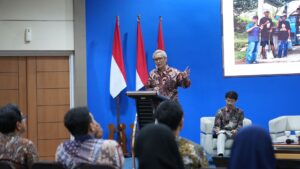
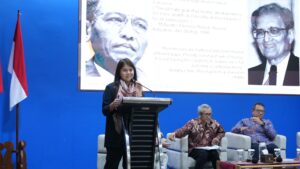
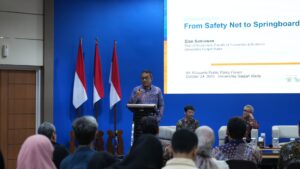
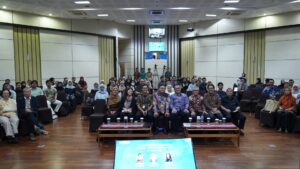
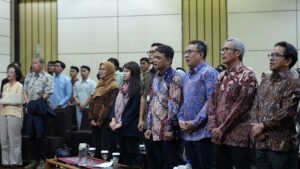
The Faculty of Economics & Business Universitas Gadjah Mada and ANU Indonesia Project hosted The 9th Mubyarto Public Policy Forum on Friday, 24 October 2025.
Since 2017 The ANU Indonesia Project in collaboration with the Faculty of Economics and Business at Universitas Gadjah Mada has convened the Mubyarto Public Policy Forum (MPP) on an annual basis to commemorate Professor Mubyarto, a distinguished economist at Universitas Gadjah Mada and a pivotal intellectual figure in Indonesia’s rural development discourse during the 1960s through the 1990s.
This year’s MPPF theme is Poverty and welfare reform in Indonesia and the key lecture was delivered by Sudarno Sumarto (Honorary Senior Research Fellow at the SMERU Research Institute).
In his keynote lecture, Dr. Sudarno Sumarto honored the legacy of Prof. Mubyarto, reminding that genuine development goes beyond economic growth it must uphold human dignity, social justice, and community empowerment. Reflecting on two decades of reform, he argued that Indonesia’s social protection must now evolve from a mere “safety net” into a “springboard” a system that not only prevents poverty but also enables upward mobility and inclusive prosperity. Although Indonesia’s poverty rate has dropped significantly, Sumarto warned that vulnerability remains widespread: nearly half the population lives below twice the poverty line, and 60 percent of workers remain in informal employment. These structural weaknesses could undermine Visi Indonesia Emas 2045. Social protection, he asserted, should no longer be treated as a fiscal burden but as a strategic investment in human capital.
Sumarto called for a renewed social contract that adapts to demographic shifts and labor market changes. He proposed an integrated architecture that unites social assistance, social insurance, and active labor market policies as a system that supports citizens “from birth to death.” He stressed that evidence-based policymaking must underpin these reforms: “good intentions without knowledge can hurt.” Drawing from impact evaluations of Indonesia’s transition from Raskin to BPNT and the expansion of PKH, he illustrated how rigorous data improved targeting, reduced poverty, and expanded access to education.
Responding to the keynote, Elan Satriawan (Universitas Gadjah Mada/TNP2K) affirmed that Indonesia’s main challenge is no longer extreme poverty but rising vulnerability among the non-poor and middle class. Using Susenas 2022–2023 data, he showed that nearly half of Indonesia’s middle class has slipped downward due to weak job quality. Elan advocated for a life-cycle social protection framework, ensuring security from childhood to old age through integrated assistance, contributory schemes, and employment-linked programs. He noted that one of the five major systemic bottlenecks is persistent targeting error, which undermines the effectiveness of social assistance by failing to reach the most vulnerable groups. More broadly, Elan emphasized that technical reforms and policy evidence alone are insufficient to drive change. Citing the reversal of the Sembako program from a voucher scheme back to cash assistance, he argued that political incentives and bureaucratic realities often outweigh empirical findings. Sustaining social protection reform requires continuous investment in strengthening institutional capacity and policy advocacy, so that Indonesia’s system becomes not only evidence-based but also politically and administratively resilient.
In her reflection, Putu Geniki Lavinia Natih underscored that achieving Indonesia Emas 2045 demands a system rooted in Prof. Mubyarto’s “Ekonomi Pancasila” – a people-centered economy grounded in equity and participation. She called for adaptive, gender- and disability-inclusive social protection, while also noting that Indonesia ranks among the world’s most disaster-vulnerable nations. Citing the World Risk Index 2023, she outlined four critical building blocks for resilience one of which is data and information systems. She highlighted the weak availability of data on persons with disabilities, reminding that “you cannot protect who you cannot see.” Integrating function-based assessments, care-economy investments, and multidimensional poverty measures is vital to capture overlapping deprivations and to design truly inclusive systems. Indonesia already has the necessary policy instruments; the challenge now is connecting them to those most deprived and most affected by shocks, so that protection translates into resilience and social justice.
The Q&A session further enriched the discussion, with participants questioning how Indonesia can maintain institutional trust and policy continuity amid program reversals and shifting priorities. Addressing this, Elan emphasized that sustaining reforms requires not only solid data but also timing, coordination, and political ownership -“policy advocacy is as important as evidence.” Other participants explored how adaptive social protection could respond to climate, aging, and disability-related challenges. Putu Geniki argued that systems must move beyond one-size-fits-all approaches and embed multidimensional and gender-sensitive data to reflect real-life vulnerabilities. Concluding the dialogue, Sumarto reiterated that the future of social protection depends on institutional learning, which requiring the humility to adapt, to collaborate, and to ensure that every reform genuinely reflects the lived realities of Indonesia’s people.
Learn more about the forum from FEB UGM
Download slides here
![[FKP hosted by The SMERU Research Institute] Estimasi misinvoicing pada kasus larangan impor pakaian bekas](https://www.fkpindonesia.org/wp-content/uploads/2026/10/Collage-8-500x383.jpg)