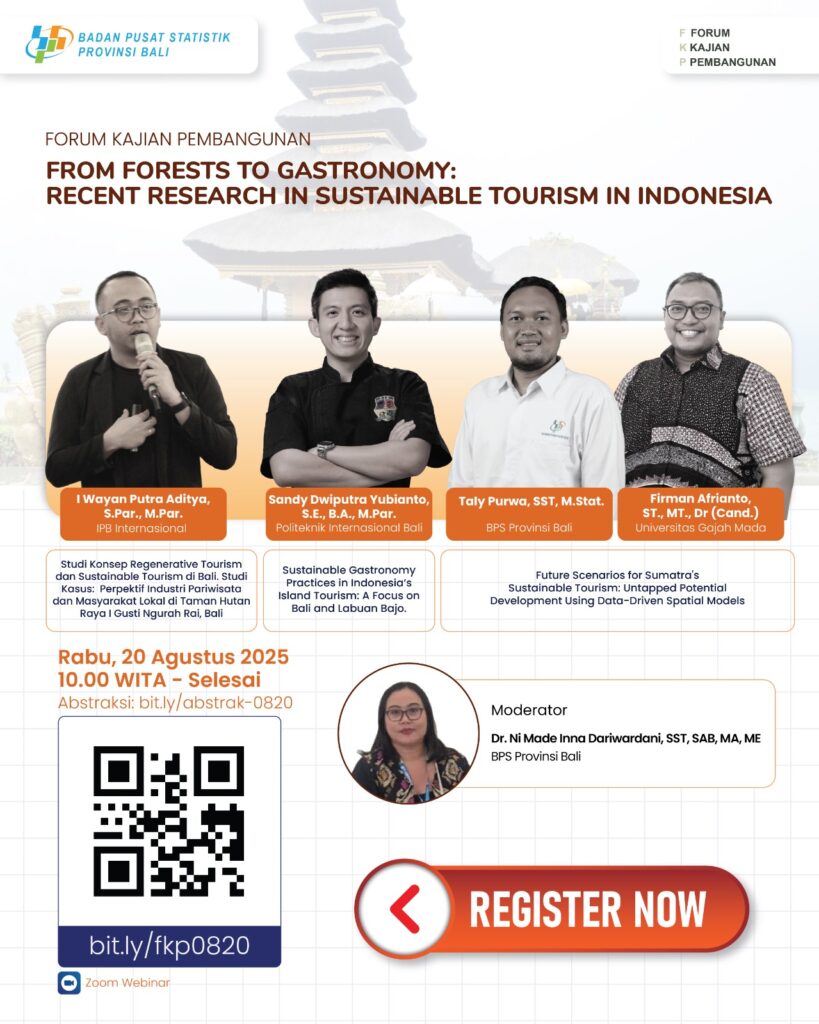
Seminar ini menghadirkan tiga kajian yang mengeksplorasi pariwisata berkelanjutan di Indonesia melalui perspektif masyarakat lokal, industri, dan peneliti, yang kesemuanya berbasis data. Ketiga paparan ini diharapkan dapat memberikan wawasan yang lebih luas untuk merancang pariwisata Indonesia yang inklusif, berkelanjutan, dan berorientasi masa depan.
Paper 1. Konsep Regenerative Tourism dan Sustainable Tourism: Perspektif Industri Pariwisata dan Masyarakat Lokal di Taman Hutan Raya (TAHURA) I Gusti Ngurah Rai, Bali
I Wayan Putra Aditya (Institut Pariwisata dan Bisnis Internasional)
Paper 2. Sustainable Gastronomy Practices in Indonesias Island Tourism: A Focus on Bali and Labuan Bajo
Sandy Dwiputra Yubianto (Politeknik Internasional Bali)
Paper 3. Future Scenarios for Sumatra’s Sustainable Tourism: Untapped Potential Development Using Data-Driven Spatial Models
Taly Purwa (BPS Provinsi Bali) dan Firman Afrianto (Program Doktor Perencanaan Wilayah dan Kota UGM)
Rabu, 20 Agustus 2025 jam 09.00-11.00 WIB
Paper 1. Konsep Regenerative Tourism dan Sustainable Tourism: Perspektif Industri Pariwisata dan Masyarakat Lokal di Taman Hutan Raya (TAHURA) I Gusti Ngurah Rai, Bali
I Wayan Putra Aditya (Institut Pariwisata dan Bisnis Internasional)
Pariwisata berkelanjutan (sustainable tourism) dan pariwisata regeneratif (regenerative tourism) merupakan dua pendekatan pengelolaan pariwisata yang berupaya menjaga keseimbangan antara kegiatan wisata dengan keberlanjutan lingkungan serta sosial-budaya. Pariwisata berkelanjutan berfokus pada pengelolaan sumber daya secara bertanggung jawab agar tetap terjaga bagi generasi mendatang, sedangkan pariwisata regeneratif menekankan pada pemulihan, perbaikan, dan peningkatan kualitas lingkungan serta kesejahteraan sosial yang terdampak. Penelitian ini berjudul “Studi Konsep Regenerative Tourism dan Sustainable Tourism di Bali: Studi Kasus Perspektif Industri Pariwisata dan Masyarakat Lokal di Taman Hutan Raya I Gusti Ngurah Rai”. Tujuan penelitian adalah (1) mengidentifikasi persepsi masyarakat lokal dan pelaku industri pariwisata terhadap kedua konsep tersebut, serta (2) menganalisis kesenjangan dan potensi sinerginya dalam pengelolaan kawasan. Metode yang digunakan adalah deskriptif kualitatif melalui observasi dan studi dokumentasi, dengan analisis menggunakan NVivo. Hasil penelitian menunjukkan pariwisata regeneratif di Tahura dapat diwujudkan melalui lima elemen kunci: (1) pemulihan dan konservasi ekosistem mangrove, (2) pendidikan dan kesadaran pengunjung, (3) peningkatan kualitas hidup masyarakat, (4) kontribusi ekonomi melalui lapangan kerja dan diversifikasi usaha, serta (5) pemberdayaan komunitas lokal. Analisis perbandingan mengungkap bahwa kolaborasi antara industri dan masyarakat sangat penting. Industri berperan menyediakan fasilitas ramah lingkungan, promosi budaya, dan program konservasi, sedangkan masyarakat lokal memberikan pengetahuan tradisional dan partisipasi aktif. Sinergi ini berpotensi menjadi model pengelolaan pariwisata regeneratif yang mampu memulihkan ekosistem, memperkuat ekonomi lokal, dan melestarikan budaya Bali.
Paper 2. Sustainable Gastronomy Practices in Indonesias Island Tourism: A Focus on Bali and Labuan Bajo
Sandy Dwiputra Yubianto (Politeknik Internasional Bali)
Sustainable tourism, according to the United Nations Environment Program and the World Tourism Organization, involves developing tourism that considers economic, social, and also environmental impacts, ensuring the benefits for current and future generations. The 2 iconic islands destination in Indonesia, Bali and Labuan Bajo, have offered distinctive opportunities in implementing sustainable tourism practices through their specialty beverage products. The study aims to explore how the traditional practices and natural resources in these islands contribute to sustainable tourism development. Labuan Bajo highlights Sopi wine, a distilled beverage from the plants of lontar palm which are deeply rooted in cultural heritage and community livelihoods. Whereas in Bali, a well know herbal drink called Loloh Cemcem sourced from Penglipuran Village, showcasing the commitment to cultural preservation and sustainable resource use. This research employs a qualitative approach, combining descriptive analysis and focus group discussions. The results reveal that both islands make good use of their geographic and cultural contexts to develop sustainable specialty products, enhancing tourism appeal, supporting local economic, and ensuring long-term resource viability.
Paper 3. Future Scenarios for Sumatra’s Sustainable Tourism: Untapped Potential Development Using Data-Driven Spatial Models
Taly Purwa (BPS Provinsi Bali) dan Firman Afrianto (Program Doktor Perencanaan Wilayah dan Kota UGM)
This study measures the performance and development of sustainable tourism in Sumatra and Indonesia in 2019-2022 through the formation of the Sustainable Tourism Index (IPB), measuring the centrality of provinces in the tourism network structure, and evaluating the sustainability of the tourism sector through simulations of several policy scenarios by utilizing the Spatial Sustainability Assessment Model (SSAM). In addition, spatial regression modeling is also applied to identify the driving and inhibiting factors of the number of domestic tourist visits both at the national level and in Sumatera. The results of the study show that Sumatera has quite promising tourism potential. However, its performance is still relatively moderate. North Sumatra experienced a significant increase in IPB, supported by the development of Lake Toba as a priority destination and the Sei Mangkei Special Economic Zone (KEK). Tourism network analysis shows that South Sumatra, Bangka Belitung, and Jambi stand out in centrality indicators, while Aceh shows low centrality. This study also found that policy scenarios that balance environmental and social aspects have the greatest positive impact on sustainability. The spatial regression model shows positive spatial dependency, with the largest driving factor for the number of domestic tourists coming from the share of the Accommodation and Food and Beverages sector.
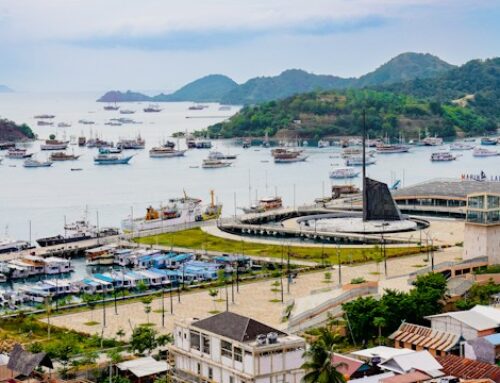
Photo by Sören Funk on Unsplash
Slides and video for past seminars: